
Key Takeaways
- AI automation vs AI augmentation – AI automation handles predictable tasks while AI augmentation works alongside people to support creative decision-making.
- Neither approach is universally better. The right choice depends on the task requirements
- Business can combine AI automation vs human augmentation to automate routine tasks while humans are involved in strategic and creative decisions.
- In digital marketing AI can automate campaign routine execution and reporting while augmenting content creation, audience insights, strategy and creative decisions.
What Is the Difference Between AI Automation and AI Augmentation?
With the advancement of technology, 40% of working hours could be impacted by generative AI
proving that it has become an irreplaceable part of our workforce. More employees increasingly seek the help of AI for their tasks.
Statistics suggest 75% of global knowledge workers use AI at work for easier and faster work flows. But for companies looking to adopt AI technology, the question arises – AI automation vs AI augmentation. Understanding the difference between AI augmentation vs automation and the role of AI automation tools can help businesses choose the right approach for their needs.
Let’s take a look at AI augmentation vs AI automation differences
What Is AI Automation?
AI automation uses artificial intelligence to perform tasks with minimal human intervention. These tasks are often repetitive, rule-based and time consuming. With AI automation businesses can save time, reduce errors, and improve efficiency. AI assistance increased customer-support productivity by nearly 14% on average.
Increased customer-support productivity , faster data entry, invoice processing etc can be achieved with AI automation tools and AI augmentation.
What Is AI Augmentation?
AI augmentation uses AI to support the workforce rather than replace them. A study suggests generative AI improved consultants’ performance by 25% on tasks within its capabilities..
AI augmentation helps employees analyze information, generate ideas, and complete tasks efficiently. For example, an AI-augmented marketing strategy can help marketers generate content ideas, analyze latest trends and help in decision-making.
AI Automation vs AI Augmentation at a Glance
AI has found its place in several workflow applications across businesses. 88% of organizations report using AI in at least one business function in McKinsey’s 2025 survey.
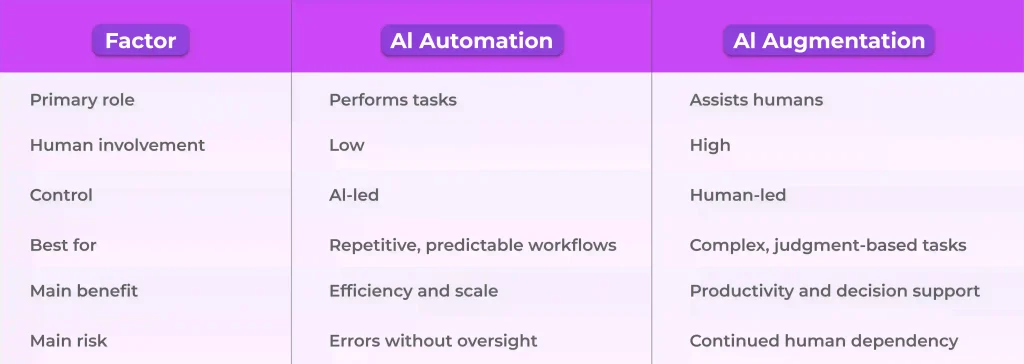
While AI automation can take over repetitive tasks and reduce manual effort, AI augmentation works alongside the employees to enhance their capabilities while keeping humans in control.
AI Automation vs AI Augmentation: Key Differences
Implementation and Operating Costs
AI automation may require higher initial investment to integrate tools and redesign workflows, but it can also reduce ongoing costs by minimizing repetitive manual work.
In AI augmentation vs automation, augmentation doesn’t replace employees but works alongside them to enhance existing processes, while AI automation takes over specific tasks with minimal human intervention.
Human Oversight and Control
For automation vs augmentation in AI, human oversight ensures that AI remains under human direction, particularly when decisions have significant impact. It allows employees to review, correct, or override AI inputs, helping prevent errors, bias, and decisions that may conflict with ethical or organizational standards.
Productivity and ROI
AI automation can improve ROI by reducing manual effort, processing time and operational costs.
AI augmentation can also improve employee productivity, decision-making and work quality in many different ways. For businesses, both AI automation, AI augmentation, can create a balance between operational efficiency and human expertise.
AI Automation vs AI Augmentation Examples
There are several AI automation vs AI augmentation examples including
Marketing and Content
AI automation can streamline tasks such as social media publishing, email campaigns, and data data analysis, reducing the repetitive work for the marketing teams.
An AI-augmented marketing approach on the other hand helps marketers with social media marketing strategies, audience insights, campaign analysis, and personalization while leaving creative direction and final decisions to humans. This is a good AI automation vs AI augmentation example, where both approaches work together to improve efficiency.
Customer Service
AI automation can handle routine customer service tasks such as answering FAQs, routing tickets, and sending automated updates, reducing response times and manual workload.
Research suggests AI augmentation, through AI assistance, increased customer-support productivity by nearly 14% on average, helping agents handle more complex interactions by suggesting responses, customer history, and providing relevant information in real time. This allows AI to manage routine interactions while agents focus on complex issues that require human judgement and personalized responses.
Sales and Lead Management
AI automation, automates updation of CRM pipeline stages and assigns sales representatives based on buyer behaviour. It can also extract data from standard sales agreements and file them directly into relevant legal databases, reducing repetitive administrative work.
AI Augmentation can analyze call recordings and suggest relevant objection-handling points for sales representatives. It can further flag contract risks and highlight-non standard terms, helping teams make better-informed decisions while making human judgement involved.
Software Development and Testing
AI automation can automate repetitive development tasks such as running tests, checking code for errors, and identifying vulnerabilities. It can also flag or fix certain low-risk issues automatically, reducing the need for manual intervention.
AI augmentation helps developers write and improve code by providing code suggestions, identifying potential issues, and recommending solutions. Developers can then review these suggestions and decide what to implement, keeping human expertise involved.
Benefits and Limitations of AI Automation and Augmentation
AI automation and augmentation are both approaches that are employed in various industries and
applications. AI automation vs AI augmentation – let’s take a look at the key benefits and limitations of both.
| Approach | Key Benefits | Limitations |
| AI AUTOMATION AUTOMATED WORKFLOWS Setting up monotonous, predictable marketing tasks ( e.g. scheduled social posts, drip email flows, drip email flows, lead nurturing etc,) | Time Saving & Scale AI-powered automation rapidly scales routine marketing tasks, providing faster, highly consistent execution. Operational Efficiency Once workflows are set AI automation reduces manual inputs in daily distribution and tracking. | Inflexibility AI automation can struggle with unexpected situations and creative decisions. |
| AI AUGMENTATION AUGMENTED STRATEGY Using AI as an active copilot alongside team members for creative, analytical and strategic marketing tasks (e.g. campaign ideation, audience insight synthesis, deep data analysis, personalization) | Elevated Decision- Making AI augmentation combines machine data synthesis with human intuition to provide smarter high-performing campaigns. Creative & Productive Boost It helps generate audience aligned concepts for sharper and faster targeting | Human Bottleneck Requires continuous human reviews before applying AI inputs Risk of Automation Bias Marketers may rely solely on AI recommendations without relaying insights. |
The value of AI marketing goes beyond the AI automation and AI augmentation comparison. AI-augmented marketing tools can help teams understand
audiences,generate creative ideas, analyze campaign performance, identify opportunities while marketers remain responsible for strategy and decision-making.
This human AI collaboration can support emerging approaches such as advocacy advertising, where understanding audience sentiment helps create a relevant brand persona.
When Should Businesses Use AI Automation vs AI Augmentation?
AI automation vs AI augmentation, which should businesses choose?
The answer largely depends on the task. AI automation is best suited for high-volume, rule based activities where speed, scale and constituency are priorities. AI augmentation benefits businesses in complex, brand-critical decisions that require human judgement.
Let’s take a look at AI automation vs AI augmentation examples across branding and digital marketing.
Choose AI Automation for Repetitive Tasks
AI-powered automation is increasingly becoming an important part of the future of AI in branding particularly for predictable marketing activities that can follow predefined rules. For example, paid and performance marketing platforms can automate bidding in real-time based on a preset threshold. AI automation can help with dynamic ad personalization by providing pre-formatted creatives to users based on their browsing behaviour, location, or demographic data.
Similarly, AI email marketing and lead nurturing can send out automated emails based on user actions, categorize leads into relevant segments, and move prospects through predefined pipelines. AI automation can further support routine analytics, reporting and structured data management, allowing the marketing teams to spend less time on repetitive execution.
Choose AI Augmentation for Complex Decisions
AI augmentation works best in digital marketing when a task requires creative intuition, brand voice, strategic judgment, or complex analysis. In AI augmentation vs automation, augmentation is particularly effective for high-stakes content and copy writing where AI can help co-write long-form articles, whitepapers, and opinion pieces while human experts refine the content and verify the accuracy.
AI augmentation can also support brand voice alignment, ad copy variations and test different creative angles. AI-Augmented Marketing can further assist with campaign brainstorming, audience persona building, customer journey and funnel analysis, sentiment and trend mining.
Combine Automation and Augmentation for End-to-End Workflows
AI automation vs AI augmentation, doesn’t have to be a competition. Businesses don’t have to choose between the two. Combining both can create ended-to-end workflows where AI handles repetitive execution while marketers provide strategy and creative direction.
Market Insight → Campaign Strategy → Creative development → Launch → Monitoring → Optimization → Learning
Digital PR is a good example.
AI can collect and organize market trends, automate campaign setup and monitoring and perform routine actions throughout the workflow. For marketers considering AI-augmented marketing vs traditional marketing, AI augmentation adds another layer of support, by helping interpret market trends, develop the campaign strategies, refine creative direction, and determine how campaigns should evolve. This creates an end-to-end workflow where automation handles execution and augmentation strengthens strategic decision making.
Media Monitoring → Opportunity Identification → Pitch Development → Outreach → Coverage Tracking → Performance Analysis
In a digital PR workflow, AI automation can handle repeated activities of listening, tracking, and reporting, while. AI augmentation supports pitching, relationship building, and storytelling. Together, they reduce routine work while helping PR teams turn insights into meaningful media opportunities.
AI Automation and AI Augmentation Tools
AI tools can support different stages of digital marketing, from ideation and content creation to campaign execution and analysis. The right tool depends on whether marketers need to automate a task or augment their expertise.
Brainstorming tools for instance, helps marketers generate campaign ideas, content angles, headlines, and creative concepts. Digital marketing tools can automate tasks such as scheduling, email, workflows, reporting and lead management. AI-augmented marketing tools support audience analysis, content development, personalization, campaign strategy, helping enhance human decision making.
AI Image generators are part of AI augmentation tools that help marketers quickly visual concepts, create campaign assets, and develop creative variations. Other AI include ChatGPT, Gemini, and alternatives to ChatGPT can support content research and development, brainstorming.
How to Choose the Right AI Approach for Your Business
The right AI approach depends on your goals and the tasks you want to improve. In branding & digital marketing, automation works best for repetitive, restricted tasks, while augmentation supports creativity, strategy, and human judgement.
For brands seeking online visibility for your business, combining both approaches can strengthen marketing execution and decision making. The best digital marketing agency can identify where AI can support your strategy while improving search visibility and audience engagement.
FAQ
- What is the difference between AI automation and AI augmentation?
AI automation uses AI to perform tasks with minimal human intervention, while AI augmentation works alongside people to enhance their decision making capabilities. - Is AI automation better than AI augmentation?
For an AI automation and AI augmentation comparison neither can be claimed as the better option. In AI augmentation vs automation, AI automation is better suited for repetitive tasks, while AI augmentation is more effective for tasks requiring creativity, and human judgement.
- What are examples of AI automation?
Automated data entry, invoice processing, customer support routing, appointment scheduling, email workflows, inventory management are AI automation examples. - What are examples of AI augmentation?
As compared to repetitive AI automation tasks -Software coding, AI assisted customer support, medical decision support, data analysis, customer service, content ideation are some AI augmentation examples. - Can businesses use AI automation and augmentation together?
Yes, businesses can automate repetitive execution while using ai augmentation to support strategy, creativity, analysis, and other tasks requiring human expertise. - Which is more cost-effective: AI automation or AI augmentation?
It depends on the task and implementation. Automation can reduce costs by handling repetitive work at scale, while augmentation can improve employee productivity and decision making potentially creating greater value over time.