
AI Augmented Marketing vs Traditional Marketing is one of the most discussed topics regarding modern marketing. With its analytics and predictive abilities, artificial intelligence technology is changing the face of marketing operations today. Just like traditional marketing techniques have their own value in the business environment, the new digital environment requires quick decisions.
Currently, organizations are operating in a highly competitive digital environment where customer needs are changing rapidly. Marketing teams are facing challenges like analyzing a huge amount of data and personalizing messages. Here, the combined use of AI and marketing is helping organizations to function more efficiently.
This is why businesses that want to create a robust AI-assisted marketing strategy must know the difference between AI-driven marketing strategies and traditional marketing models. With this, businesses will learn how to build better marketing strategies.
Key Takeaways
- AI-augmented marketing involves data analysis, predictive insights, and automation tools.
- The key features of traditional marketing are manual planning, experience-based decision making, and fixed campaign structures.
- AI enhances campaign targeting, personalization, and performance tracking.
- A balanced AI-Augmented Marketing approach implies technology with human creativity.
- Proper adoption of AI ensures ethical marketing and customer trust.
What Is AI-Augmented Marketing?
AI-augmented marketing is the integration of artificial intelligence technologies into marketing processes to support human decision-making. These machine learning systems analyze consumer behavior, campaign performance, and engagement patterns to generate insights that help marketers plan smarter strategies.
Modern platforms use AI to evaluate large datasets quickly. This allows marketing teams to predict customer preferences, identify emerging market opportunities, and optimize messaging in real time. AI tools also assist with automated email campaigns, ad targeting, and customer segmentation.
Companies exploring the use of AI in marketing often build a structured AI Augmented Marketing plan that connects analytics, marketing automation, and customer insights. For a deeper explanation of what is AI-augmented marketing and how these systems function, businesses today refer to detailed resources that explain practical applications and real-world use cases.
What Is Traditional Marketing?
Traditional marketing strategies rely on manual planning, human intuition, and conventional media channels. These include print advertisements, television commercials, radio campaigns, outdoor advertising, and basic digital promotions.
Marketing teams historically relied on surveys, experience, and limited performance metrics to evaluate campaigns. While these methods helped brands establish recognition, they lacked real-time feedback and advanced targeting capabilities.
Brand building still plays a central role in traditional strategies, as entrepreneurs in the past were also aware of the importance of branding in business and the role of brand positioning. Businesses that invest in consistent identity and messaging often see stronger customer trust.
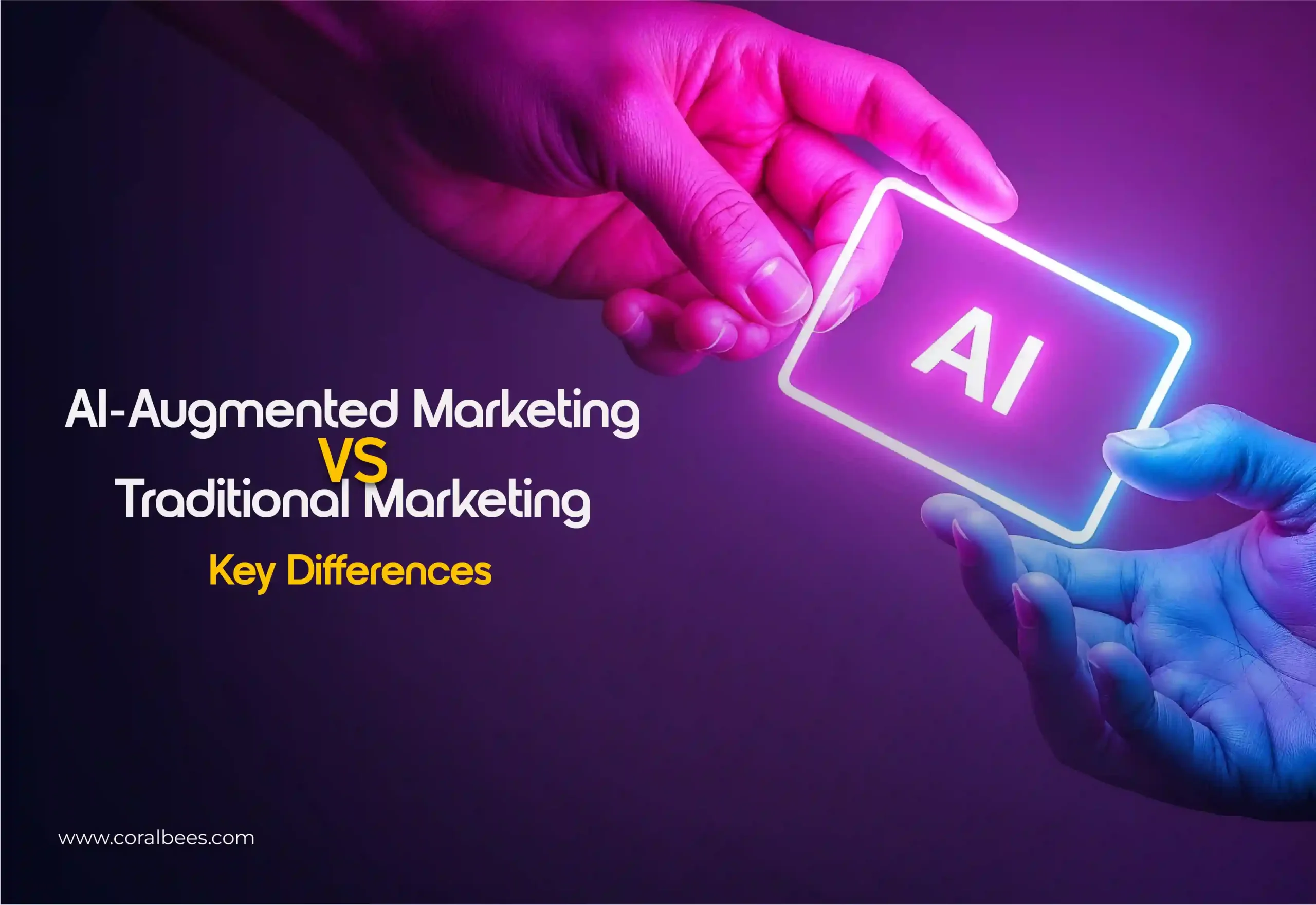
AI-Augmented Marketing vs Traditional Marketing
The comparison between AI Augmented Marketing vs Traditional Marketing becomes clearer when examining how decisions are made, campaigns are executed, and audiences are targeted.
Data-Driven Decision Making
Traditional marketing decisions rely heavily on historical reports and the marketer’s experience. Data analysis can take days or weeks, which slows strategic adjustments.
AI systems analyze massive datasets within seconds. This helps marketing teams discover customer trends and optimize campaigns rapidly. Strong data insights also support improved search visibility and digital exposure.
Automation and Efficiency
Campaign management in traditional marketing requires extensive manual work. Tasks such as audience segmentation, ad scheduling, and reporting demand significant time.
With AI in marketing automation, these activities become faster and more scalable. Automation platforms manage email campaigns, ad bidding strategies, and performance monitoring with minimal manual input.
Personalization at Scale
Traditional marketing communicates the same message to large audiences. Personalization is limited due to resource constraints.
AI systems analyze behavioral signals and create personalized messaging for different audience segments to increase brand awareness. This capability improves engagement and supports long-term brand awareness strategies.
Benefits of AI-Augmented Marketing
Organizations adopting an AI Augmented Marketing approach often experience measurable improvements in marketing performance.
Predictive Customer Insights
AI algorithms evaluate historical data and behavioral patterns to predict customer interests. This allows marketing teams to anticipate market demand and prepare targeted campaigns.
Improved Campaign Performance
AI-powered tools continuously analyze campaign metrics and recommend improvements. Marketers can adjust messaging, targeting, and budgets based on real-time performance data. As a business owner, you can also strengthen your digital presence by improving online visibility for your business.
Better Customer Experience
AI-driven chatbots, recommendation engines, and personalized marketing messages enhance customer interaction with brands. These systems allow businesses to deliver relevant content that matches user preferences.
AI-Augmented Marketing Best Practices
Organizations that adopt AI tools must apply them carefully to maximize results and maintain ethical standards.
Use AI for Data Analysis, Not Just Automation
Many companies use AI only for automation tasks such as email scheduling or ad management. Advanced AI platforms can also identify trends, predict campaign performance, and evaluate audience behavior.
Marketers who rely on strong and top digital marketing tools and analytics tools often improve productivity and strategic planning.
Maintain Human Creativity
AI systems analyze data effectively, yet creative thinking remains essential in marketing. Human marketers bring storytelling, emotional understanding, and brand identity into campaigns.
Creative strategy continues to shape digital communication across various platforms, including the top live streaming apps.
Build a Responsible AI Marketing Strategy
Ethical marketing practices remain important when AI systems handle customer data and automated communication. Businesses should develop a clear, responsible AI marketing strategy that ensures transparency and data protection.
Organizations that combine ethical data usage with strong marketing frameworks often achieve better brand credibility. Companies seeking expert support often consult the best digital marketing agency to design responsible digital strategies.
Real-World Examples of AI in Marketing
The practical use of AI in marketing can be seen across multiple industries.
AI in Customer Segmentation
AI tools analyze behavioral signals, demographics, and purchase history to group customers into meaningful segments. Marketing teams can then deliver targeted campaigns that resonate with specific audience groups.
Audience segmentation becomes even more powerful when brands understand where their customers spend time online, on the top social media platforms in India and other specific regions.
AI in Content Personalization
Content personalization systems analyze browsing behavior and recommend relevant articles, videos, or products. Streaming platforms, e-commerce websites, and SaaS platforms rely heavily on this technology.
Personalized content also improves results, which is one of the top benefits of social media marketing.
AI in Advertising Optimization
Digital advertising platforms increasingly rely on machine learning to optimize targeting, bidding strategies, and ad placement. AI continuously tests campaign variations and identifies the most effective combinations.
AI optimization also supports specialized advertising models, such as advocacy advertising campaigns.
Emerging AI-Augmented Marketing Trends 2026
Several AI Augmented Marketing trends are likely to influence digital marketing strategies in the year 2026.
Firstly, predictive analytics will be an essential aspect of the marketing strategy. AI will be able to forecast consumer behavior more accurately. This will enable businesses to plan their budget more effectively. Secondly, AI content generation will continue to grow in blogs, email marketing, and social media campaigns. Marketing will continue to be supervised by the teams.
Thirdly, advanced analytics will be able to determine the most effective posting times. Businesses that use social media campaigns should consider learning more about timing strategies. For instance, the best times to post on Instagram and other platforms will be important to consider.
Lastly, integrated digital marketing frameworks will be able to bring together AI, branding, SEO, and social media strategies. Businesses that develop these frameworks will need to learn more about branding & digital Marketing.
Conclusion
Debates on AI-Augmented Marketing vs Traditional Marketing emphasize the impact of technology on the evolution of modern marketing practices. The benefits of AI-Augmented Marketing include the ability of marketers to process data faster, personalize marketing campaigns, and improve the performance of marketing campaigns through the power of technology.
Traditional marketing practices are equally important as they bring a lot of strategic thinking and creativity to the marketing function. Organizations need to benefit from the best of both worlds by having the best human expertise combined with the power of intelligent marketing technology.
An organization that adopts a well-defined AI-assisted marketing strategy, keeps up with AI Augmented Marketing best practices, and monitors emerging AI Augmented Marketing trends, will remain competitive in the dynamically changing digital marketing landscape. For those interested in knowing more about the latest strategies in marketing, they may need to look at the latest developments and recent trends in digital marketing.
FAQs
- What is AI-augmented marketing?
AI-augmented marketing is the use of AI technology to analyze data, automate campaigns, and aid marketers in their decision-making processes. - How is AI marketing different from traditional marketing?
The traditional concept of marketing relies on data analysis and decision-making based on experience and using conventional media channels; AI marketing uses data analytics and predictive analysis. - Is AI replacing digital marketers?
No, AI is assisting digital marketers in analyzing the data and automating the processes. Creativity and strategic thinking are still the essential requirements of marketers. - What are examples of AI in marketing?
The examples of AI in marketing include predictive analytics, AI chatbots, automated advertisement optimization, and personalized content suggestions. - How does AI improve marketing performance?
The performance of marketing is enhanced by the accuracy of the marketing targets, the quick evaluation of the performance of the marketing campaigns by AI, and the optimization of marketing strategies. - Can AI replace traditional marketing completely?
The role of AI in marketing is not to replace the role of traditional marketing but to enhance the performance of marketing. - What are the risks of using AI in marketing?
Data privacy concerns, algorithm bias, and excessive automation without human oversight are the major risks. - Is AI marketing suitable for small businesses?
Many AI marketing tools are affordable for small businesses and are helpful in improving the performance of digital marketing campaigns.