
Key Takeaways
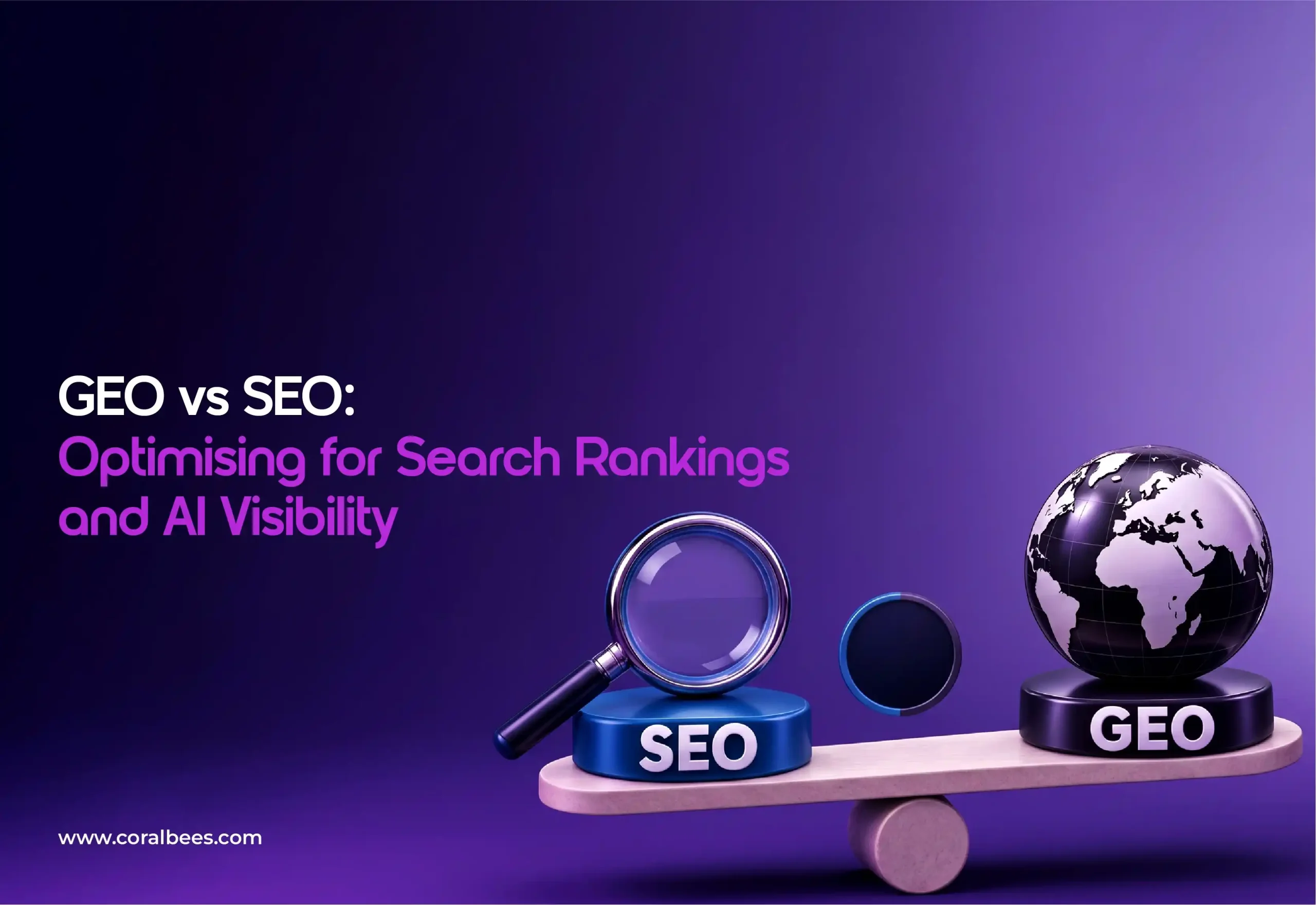
- GEO SEO meaning: SEO targets traditional search, while GEO targets AI-generated answers.
- What is SEO GEO? They work together to improve visibility across search engines and AI platforms.
- Optimize for both: Combining SEO and GEO creates a stronger, more future ready search strategy.
What Is SEO?
Search Engine Optimization (SEO) is the practice of optimizing your website and content to increase search visibility, drive organic traffic, and build brand authority across search engines.
How SEO Works
SEO is all about being found when people search for related services. It involves structuring and refining your site so search engines like Google can easily understand what your brand offers and recommend you to the right audience.
What SEO Optimises For
SEO focuses on user intent i.e targeting the exact terms your potential customers are searching for. This allows you to align your content to provide the clearest, most helpful answer while building trust through site performance and endorsements (links) from other reputable websites.
Common SEO Strategies
Common SEO strategies include:
- On-page SEO: Creating valuable, high-quality content targeting relevant search terms.
- Off-page SEO: Earning backlinks and mentions from authority sites to build credibility.
- Local SEO: Optimizing your Google Business Profile and local presence to reach nearby customers.
What Is GEO?
Today the goal isn’t just to rank on search engines but to be discovered and recommended by AI models such as ChatGPT, Gemini, Google AI Overviews, Claude etc. AI visibility is now a key part of brand discovery. In 2026 a study revealed 78% of AI-search citations went to corporate websites, establishing the importance of authoritative online presence.
GEO Meaning
While SEO focuses on traditional search search engines, GEO is the practice of tailoring your content so AI models can easily understand, cite and reference your brand as a trusted source. Traditional SEO focuses on driving clicks from search results; GEO ensures your brand is part of direct answers delivered to users through GEO AI search.
How GEO Works
GEO focuses on how Large Language Models (LLMs) gather and evaluate information. Instead of simply matching keywords, AI models check for clarity, expertise, and brand authority.
So when it comes to GEO vs SEO, GEO doesn’t only optimize content to rank higher in search results. It aims to make information easy for AI models to extract and cite. With AI Overviews appearing for 13.14% of queries in March 2025, optimizing for AI-driven discovery is important for AI-augmented marketing.
Where GEO Appears
GEO can help your brand appear across different AI-driven discovery platforms:
- AI Search Results: Google AI Overviews display AI generated summaries with source cards and links to relevant websites
- AI Assistants: Tools such as ChatGPT, Perplexity, Gemini, and Claude can surface information about brands when answering user queries.
- AI Product Discovery: AI-powered shopping experiences including Google Shopping, Amazon etc. can recommend products and brands based on the users search.
Over 80% of the consumers rely on zero-click results for at least 40% of their searches. GEO helps increase brand awareness beyond traditional rankings by making your brand visible in AI-driven search experiences.
What GEO Optimises For
We know that SEO optimizes for search engines crawlers and blue link rankings, GEO optimizes for AI language models to understand, quote, and recommend your brand as an authority.
GEO optimizes for information density, high information gain, citation worthiness, and semantic authority and factual accuracy. These factors help AI models identify useful and trustworthy information when generating responses. This shift is also part of highlighting why businesses need to consider GEO or SEO depending on where their audience is searching.
GEO vs SEO: What Is the Difference?
Most businesses today use SEO and GEO interchangeably. but they serve very different purposes.
What is the difference between SEO and GEO?
SEO focuses on ranking your website at the top of traditional search result pages to drive clicks, while GEO focuses on structuring your content making it easy for AI models to understand and recommend.
SEO vs GEO
| Factor | SEO | GEO |
| Primary environment | Search engines | Generative AI/search experiences |
| Main objective | Improve search visibility and rankings | Increase visibility in AI-generated responses |
| User input | Keywords and search queries | Natural-language prompts and questions |
| Output | Ranked search results | Synthesised AI-generated answers |
| Content focus | Relevance, quality, search intent | Clarity, context, factuality, citability |
| Key visibility signal | Rankings and SERP presence | Mentions, citations and AI visibility |
| Main KPIs | Rankings, clicks, traffic, conversions | Mentions, citations, share of voice and AI referrals |
| Technical foundation | Crawling, indexing, architecture, performance | Same foundational accessibility plus content clarity and machine-readable information |
| Off-site signals | Links, authority, mentions | Mentions, references, entity consistency and authoritative sources |
SEO Targets Rankings; GEO Targets AI Visibility
SEO aims to secure a high ranking on search engine result pages (SERPs) to earn click-through traffic to a website.
GEO focuses on positioning your brand and insights making them visible in AI-generated direct answers across platforms such as Google AI Overviews, ChatGPT, Gemini, and Claude etc.
SEO Uses Keywords; GEO Emphasises Questions and Context
SEO works on building content around specific search queries, short-tail or long-tail keywords, and search volume.
GEO places emphasis on natural language prompts, conversational questions, entity relationships, and semantic context so AI models easily understand and synthesize the information.
SEO and GEO Have Significant Overlap
SEO and GEO both benefit from E-E-A-T (Experience, Expertise, Authoritativeness, and Trustworthiness), strong technical performance, mobile usability, clear site architecture, and well-structured content.
SEO and GEO Use Different Measurement Frameworks
So, how is GEO different from SEO? Another key difference is how their effectiveness is measured.
SEO commonly tracks ranking, organic CTR, keyword impressions, and website sessions. They can be tracked with various digital marketing tools.
GEO can be evaluated through AI Citation Frequency, Generative Share of Voice (SOV), brand mentions in AI-generated answers, and referral traffic from AI sources.
This distinction is part of the broader shift from the AI-augmented marketing vs traditional marketing ideology. Now, brands need to optimize for both traditional search and AI-discovery.
Is GEO Replacing SEO?
A common query today – is GEO replacing SEO?
Why GEO Is Not a Replacement for SEO
Although both GEO and SEO are aimed to increase brand visibility, they have different user intents and touchpoints. SEO focuses on rankings, website traffic, and high-intent users, while GEO focuses on making your brand more visible in AI-generated answers. This makes GEO vs SEO marketing less about choosing one and more about using both strategically.
How SEO Supports GEO
SEO helps search engines crawl, understand and retrieve website content. Clear site structure, internal linking, authoritative backlinks, E-E-A-T, and structured data can also create a strong foundation for GEO.
Users looking for what is GEO like SEO- Both aim to make information accessible and relevant through different methods.
When Should Businesses Focus on GEO?
GEO in marketing is growing significantly important when it comes to improving visibility alongside traditional rankings. If your target audience uses AI to compare options, ask questions, research solutions, or look for recommendations, your brand needs to be visible beyond search results.
This makes GEO an important part of an AI-augmented marketing strategy, working alongside SEO rather than replacing it.
Why Businesses Need Both SEO and GEO
SEO builds visibility in traditional search, while GEO helps brands compete for visibility in AI-generated answers. Surveys suggest 91% of leadership had asked about AI search visibility in the past year, highlighting how AI search is a business priority today.
Businesses need to adopt an AI-driven approach now more than ever as the future of AI in branding continues to shape how audiences search and engage with brands.

How to Optimise Your Website for Both SEO and GEO
A strong GEO for website strategy builds on the foundations of SEO while making content easier for AI systems to understand and reference. Here are some ways to optimize for both-
Create Helpful, People-First Content
Create useful content. Original content that answers real customers can support your digital marketing efforts. Content that exhibits experience, expertise, and clear information helps serve people first while being understood by AI systems.
Answer Questions Directly
Address specific user questions with clear answers. Concise definitions and direct responses make content easier for search engines and AI systems to understand.
Build Topical Authority
Create content that has connected text around your core topics rather than publishing isolated articles. Strong topical coverage helps establish your website as a relevant and authoritative source, whether users discover you through SEO or GEO.
Strengthen Entity and Brand Signals
Keep your brand name, services, expertise, and leaders clearly and consistently defined across your website and relevant third-party platforms. Schema markup, business profiles, reviews, and digital PR, can also strengthen your brand’s online presence and authority.
Improve Technical SEO
It is important to have a fast, secure and mobile optimized site for GEO and SEO. Make sure search engines can crawl and index your pages and that important information is accessible through a clear, well structured website.
Make Important Information Easy to Understand
Use clear headings, short paragraphs, bullet points, tables, and concise summaries to make information easier for readers to navigate. This improves user experience while helping search and AI search engines identify important facts and context.
Together, these practices create a stronger foundation combining search visibility with AI-driven discovery with AEO and GEO as part of broader branding and digital marketing strategy.
GEO vs SEO: Which Strategy Should You Use?
SEO and GEO work together rather than compete with each other.
Use SEO to:
- Improve search rankings and organic traffic
- Capture local and high-inen searches.
- Build website authority and technical foundations
Use GEO to:
- Increase visibility across AI-generated answers.
- Make your website content easier for AI systems to understand and cite.
- Strengthen your chances of being discovered when users search on ChaGPT and other AI platforms.
Experts at the best digital marketing agency suggest that understanding answer engine optimization vs. generative engine optimization helps businesses build a stronger digital marketing strategy.
For expert support, businesses can work with experienced
SEO companies in Kerala to improve SEO and rank on ChatGPT and other AI platforms, alongside.
FAQs
1. What is the difference between GEO and SEO?
SEO focuses on improving website ranking in traditional search results while GEO focuses on increasing visibility in AI-generated answers. Both help brands reach users at different stages of discovery.
2. Is GEO replacing SEO?
No. SEO remains an important foundation for website visibility, while GEO extends that strategy to AI-driven to AI-driven search and conversational platforms.
3. Is GEO the same as AEO?
No. AEO (Answer Engine Optimization) focuses on optimising content for direct answers, while GEO (Generative Engine Optimization) focuses on visibility within AI-generated responses. They do overlap but serve different search intentions.
4. How is GEO different from SEO marketing?
GEO focuses on being understood and cited in AI-generated answers while SEO marketing focuses on driving organic traffic through blue links and website ranking.
5. How can I optimise my website for GEO?
Create clearly structured, authoritative content that directly answers users questions. Strong site structure, E-E-A-T, topical authority, and consistent brand information across all platforms support GEO.
6. Does SEO help with GEO?
Yes. Technical SEO, quality content, internal linking, backlinks, and clear site architecture can provide a strong foundation for GEO and AI-driven discovery.
7. How do you measure GEO performance?
GEO performance can be evaluated by using metrics such as AI citations, brand mentions in AI-generated answers, generated share of voice, and referral traffic from AI platforms.
8. What is GEO in digital marketing?
GEO is the practice of optimising content so AI systems can understand, retrieve, and potentially cite or mention a brand in generated answers. It is becoming an important part of modern digital marketing.
9. What is the difference between SEO and GEO for AI search?
GEO can improve chances of ChatGPT and other AI platforms understanding and referencing your brand’s information.
10. Should businesses use SEO and GEO together?
Yes. SEO helps build traditional search visibility, while GEO supports visibility across AI-driven search experiences. Using both helps create a more comprehensive search and digital marketing strategy.










What do you think?
[…] approach can help businesses maximize the benefits of social media marketing. If you’re exploring SEO companies in Kerala, look for an agency that can bring these strategies together around your business […]
[…] understand how SEO, AEO and GEO work together. If you need professional support, experienced SEO Companies in Kerala can help you build a strategy around all […]
[…] can influence how consistently your business appears across online channels, while working with SEO companies in Kerala can help businesses identify and improve the factors affecting their local […]
Comments are closed.